|
TOBI Interface A
0.1
|
|
TOBI Interface A
0.1
|
A Class to manage the DataPacket to be distributed over network. More...
#include <data_packet_impl.h>
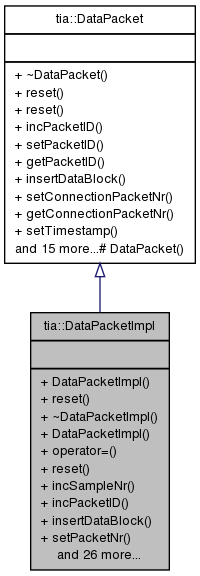
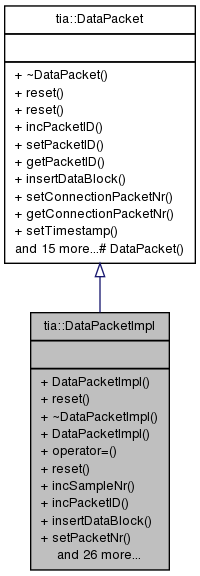
 Inheritance diagram for tia::DataPacketImpl: Collaboration diagram for tia::DataPacketImpl:
Public Member Functions | |
| DataPacketImpl () | |
| Default constructor -- building an empty DataPacket. | |
| void | reset (void *mem) |
| Resets the whole DataPacket to be (re)build a DataPacket from raw memory. | |
| virtual | ~DataPacketImpl () |
| Destructor. | |
| DataPacketImpl (const DataPacketImpl &src) | |
| Copy constructor -- does NOT copy the raw memory representation. | |
| virtual DataPacketImpl & | operator= (const DataPacketImpl &src) |
| virtual void | reset () |
| Resets the whole DataPacket (samples are deleted). | |
| void | incSampleNr () |
| Increase the static sample number by one. | |
| virtual void | incPacketID () |
| virtual void | insertDataBlock (std::vector< double > v, boost::uint32_t signal_flag, boost::uint16_t blocks, bool prepend=false) |
| Insert data (only one signal type) from a hardware device into the DataPacket (will be automatically placed correct). | |
| void | setPacketNr (boost::uint64_t) |
| Set the packet number (can differ from the samplenumber -- e.g. if sending with different rates) | |
| virtual void | setConnectionPacketNr (boost::uint64_t val) |
| boost::uint64_t | getPacketNr () |
| Set the packet number (can differ from the samplenumber -- e.g. if sending with different rates) | |
| virtual boost::uint64_t | getConnectionPacketNr () |
| void | setBoostPosixTimestamp () |
| Set the timestamp to localtime. | |
| boost::posix_time::ptime | getBoostPosixTimestamp () |
| Get the timestamp (localtime) of the datapacket. | |
| virtual void | setTimestamp () |
| Set the timestamp to localtime. | |
| virtual boost::uint64_t | getTimestamp () |
| Get the timestamp (localtime) of the datapacket. | |
| virtual bool | hasFlag (boost::uint32_t f) |
| Check, if a flag is already set. | |
| virtual boost::uint16_t | getNrOfSignalTypes () |
| Get the number of signal types stored in the DataPacket. | |
| virtual boost::uint32_t | getFlags () |
| Get the flags (including packetversion) of the DataPacket. | |
| boost::uint64_t | getSampleNr () |
| Get the sample number of the DataPacket. | |
| virtual boost::uint64_t | getPacketID () |
| virtual void | setPacketID (boost::uint64_t val) |
| virtual std::vector < boost::uint16_t > | getNrOfBlocks () |
| Get a vector containing the blocksizes for every signal type. | |
| std::vector< boost::uint16_t > | getNrOfSamples () |
| Get a vector containing the number of values (NOT channels!) for every signal type. | |
| const std::vector< double > & | getData () |
| Get all samples stored in the DataPacket as a vector. | |
| virtual std::vector< double > | getSingleDataBlock (boost::uint32_t flag) |
| Get a vector containing all samples for a specific signal type. | |
| virtual boost::uint16_t | getNrOfSamples (boost::uint32_t flag) |
| Get the number of values for a specific signal type. | |
| boost::uint16_t | getNrOfBlocks (boost::uint32_t flag) |
| Get the number of blocks for a specific signal type. | |
|
virtual std::vector < boost::uint16_t > | getNrSamplesPerChannel () |
|
virtual std::vector < boost::uint16_t > | getNrOfChannels () |
| virtual boost::uint16_t | getNrOfChannels (boost::uint32_t flag) |
| virtual boost::uint16_t | getNrSamplesPerChannel (boost::uint32_t flag) |
| virtual void * | getRaw () |
| Get a pointer to a memory region, containing the raw representation of the DataPacket. | |
| virtual boost::uint32_t | getRawMemorySize () |
| Get the size (in bytes) of the raw memory region holding the raw DataPacket. | |
| virtual boost::uint32_t | getRequiredRawMemorySize () |
| Get the required size (in bytes) to hold a given raw DataPacket. | |
| virtual boost::uint32_t | getRequiredRawMemorySize (void *mem, boost::uint32_t bytes_available) |
| Get the required size (in bytes) to hold raw DataPacket stored in RAW memory. This function can be used to check, wether a memory region is able to hold a whole DataPacket by analyzing its header. If the RAW memory Region is too small to hold the DataPacket, 0 is returned. | |
A Class to manage the DataPacket to be distributed over network.
The DataPacket class provides methods inserting Samples of different, predefined signal types (see defines.h) into a packet. Inserted data is identified through flags. The datapacket stores the acquired samples in ascending order by their signal types. (EEG first, then EMG, EOG, ...). It provides methods to get stored data wether again as a vector or in a raw representation. For raw representations, it holds raw memory objects, storing the respective representation.
Definition at line 73 of file data_packet_impl.h.
 1.7.6.1